
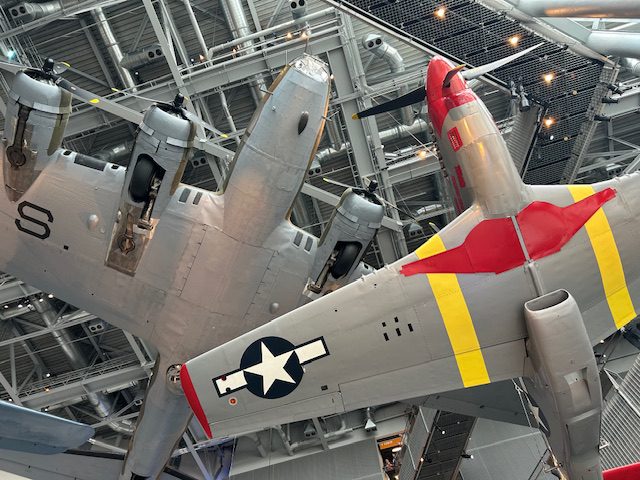
If you’ve ever been to New Orleans, as I was last week, you know that NOLA’s National World War II Museum is a must-see experience, one that immerses visitors in the scale, sacrifices, and stakes of history’s costliest conflict.
Why the National WWII Museum Matters Today More Than Ever
It had been a few years since my last visit. This time, the museum felt even more expansive and more timely. The campus has grown dramatically, with new pavilions, interactive exhibits, and deeply researched storytelling that brings history to life. A could’ve spent days there and still left feeling like there was so much more to learn.
The museum excels at balancing scale and intimacy. Combat aircraft hang overhead. Tanks and artillery pieces anchor a maze of exhibit halls. Yet what really hit home are the personal stories—letters to loved ones, recorded interviews, photographs of young men and women who stepped into the breach of history and, too often, never came back.
More than 400,000 American service members died during World War II. Among them was my cousin Joe from New Jersey, a co-pilot on a B-17 bomber shot down over France a week before D-Day. Like so many others, he fought to defend democracy and the fundamental freedoms we often take for granted—including the freedom to speak our minds.
That idea—freedom of expression—followed me into one of the museum’s most striking special exhibits.
Inside “Degenerate Art” and Nazi Censorship
Titled “Degenerate! Hitler’s War on Modern Art,” the exhibit showcases more than 65 works by prominent modern artists—painters whose only “crime” in the eyes of the Nazis was daring to express themselves beyond Hitler’s bizarre, state-approved norms. The exhibit also shows how the Nazis vilified jazz musicians, whose art can is rooted predominately in Black American history, nowhere more so than in New Orleans. The Nazis labeled jazz as “degenerate,” condemning it as immoral.
To be sure, the exhibit is not just about the arts. It’s about control. It’s about what happens when a government decides what is acceptable to create or say. It’s about the fragility of intellectual and creative freedom when confronted with authoritarian power. Walking through the gallery, you can feel that tension. You see not only the boldness of the artwork, but also the chilling consequences of a regime determined to erase it.
It was in that context, having just absorbed the dangers of suppressed expression, that I encountered something particularly unsettling.
A Jarring Discovery in the Guest Book
Near the exit of the exhibit, the museum invites visitors to express their thoughts in a guest book. Most of the entries were what one would hope for, offered appreciation for the men and women who fought to stop the spread of fascism and imperialism, and that the horrors of Nazi Germany represent a cautionary tale, never more relevant than in America today. In various iterations, many echoed the warning, often attributed to Ronald Reagan, that freedom is never more than a generation away from being lost.
But then there were other entries that left me shaking my head in dismay:
“Hitler was cool.”
“Hitler was right.”
“It’s all a lie.”
The Paradox of Free Speech
It’s one thing to study history and recognize the atrocities committed by Nazis. It’s quite another to see, in a place dedicated to remembering why we fight such atrocities, comments that dismiss or even endorse them. Yet here’s the paradox: the very freedom that allows someone to write something so offensive or ignorant is the same freedom that hundreds of thousands in World War II fought valiently to protect.
I respect the constitutional rights of whoever wrote those comments to do so. That’s the point of a free society. But that doesn’t make their sentiments any less troubling. The walkways outside the museum are paved with thousands of red bricks, each memorializing a military veteran. Did the author of “Hitler was cool” not walk over those same bricks and read some of those names before paying admission to a place that stands as the very antithesis of authoritarian rule?
What We Risk Forgetting
What such comments suggest is that the lessons of World War II are not universally understood, or perhaps not universally remembered.
Institutions like the National WWII Museum exist not just to preserve artifacts. They preserve understanding. They remind us of what can happen when intolerance, propaganda, and authoritarianism go unchecked. They show us the human cost of indifference. Indeed, an exhibit displaying so-called “degenerate art” underscores a profound truth: that when a society begins to dictate what is acceptable to think or create, it is already on a dangerously downward trajectory.
And that guest book? In its own way, it becomes part of history itself—a snapshot in real time of how Americans today, faced with the very real threat of homegrown authoritarianism, are processing (or failing to process) those lessons.
History doesn’t disappear, but it can easily repeat itself if we stop paying attention and expressing ourselves.
Walking out of the museum and into a lovely afternoon in New Orleans’ French Quarter, I found myself thinking less about weapons of war and more about their respective purposes—of freedoms defended and freedoms denied, and of the responsibility we all share in making certain the difference between the two is never forgotten.