
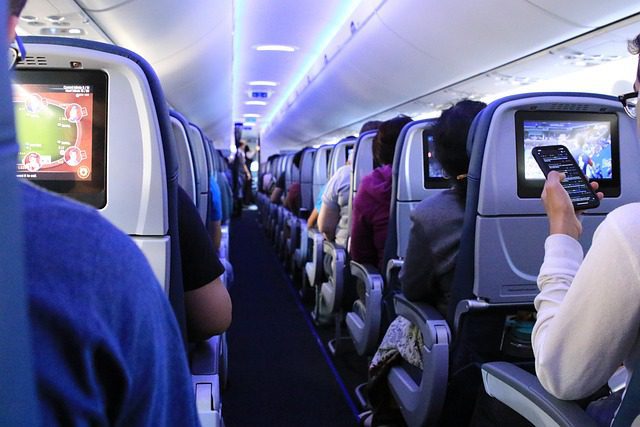
I fly frequently enough on United Airlines to qualify as a “Premier” passenger. This designation, bestowed upon me as a reward for my loyalty—or at least my continued tolerance—allows me to board early and sit in what United optimistically calls Economy Plus.
Economy Plus offers marginally more legroom, which is airline industry shorthand for “You will still suffer, but with slightly more dignity.” It also increases the likelihood that your carry-on bag will find refuge in an overhead bin, rather than being exiled to baggage claim purgatory.
But even with these modest privileges, modern airline travel remains a test of human endurance.
How Air Travel Went From Luxury to Survival
There was a time when flying felt civilized.
Meals arrived hot, served on actual plates with actual silverware. Flight attendants appeared calm, polished, and vaguely glamorous. The experience carried an air of importance.
Today, airline cabins feel more like airborne waiting rooms designed by people who actively dislike humanity. The seats are thin. The air is stale. The temperature fluctuates unpredictably. And everyone pretends this is normal.
Still, we endure. Because sometimes, getting somewhere matters more than arriving comfortably.
The Reality of Flying in a Middle Seat
Recently, I had to fly from California to Washington, D.C., on short notice. The only seat available was a middle seat near the back of the plane—the airline equivalent of exile.
The overhead bins were full, forcing my backpack under the seat in front of me, eliminating the last remaining inches of legroom. The passengers on either side of me were large enough that our individual boundaries merged into a shared territorial compromise.
Personal space became theoretical.
The Moment That Sparks Every Seat Reclining Argument
Shortly after takeoff, the woman seated in front of me reclined her seat completely.
Not gradually. Not apologetically. Completely.
Her seatback moved toward me with quiet inevitability until it hovered inches from my face. My knees pressed into the immovable barrier. My tray table pinned itself against my midsection.
At that moment, I understood the true fragility of personal freedom.
Why Reclining Your Seat on a Plane Creates Conflict
This scenario raises one of modern air travel’s most polarizing questions: Is it rude to recline your seat on an airplane?
Airlines provide the button. The option exists. But existence alone does not equal moral endorsement.
Reclining in today’s tightly packed cabins doesn’t create comfort—it redistributes discomfort.
It solves one person’s problem by creating another’s.
The Psychology of Passenger Awareness (or Lack Thereof)
As I sat immobilized, I wondered whether the woman in front of me understood what she had done. Was she aware of the chain reaction her comfort had triggered?
Or was she simply operating under the assumption that permission equals obligation?
Modern airline cabins encourage a survivalist mentality. Everyone protects their own comfort, often without considering its cost to others.
It’s not cruelty. It’s adaptation.
What Cordell Logan Would Do in This Situation
Naturally, my thoughts drifted to Cordell Logan.
Logan, the flight instructor and reluctant detective from my novels, possesses a clarity of purpose and willingness to confront uncomfortable truths.
He likely would have addressed the situation calmly but directly, using persuasion first and escalation only if necessary.
I, however, remained silent.
Because unlike Logan, I am bound by social convention—and a healthy fear of becoming viral content.
My Personal Rule for Airplane Seat Reclining Etiquette
Here is my position on reclining your seat:
If you are on a long overnight flight and everyone is trying to sleep, reclining is reasonable.
If the row behind you is empty, reclining is harmless.
But reclining fully on a crowded daytime flight, where the person behind you already lacks space, violates an unspoken social contract.
It may be allowed.
But it isn’t considerate.
Why Courtesy Still Matters in Modern Air Travel
Air travel today tests patience, resilience, and empathy.
We cannot control the shrinking seats or the crowded cabins. But we can control how our actions affect others.
Courtesy costs nothing. Awareness requires little effort.
Sometimes the most meaningful gesture is restraint.
Because at 33,000 feet, kindness travels farther than comfort.